Career Tools Have Existed for 80 Years. So Why Is Everyone Still Lost?

The question gets posted online every single day, in different words, by different people, all landing in the same place. "I don't know what to do with my life." "I have a degree and no direction." "I've tried everything and I still feel stuck." Thousands of these. Daily. From people who are not lazy, not unmotivated, not uniquely confused. Just lost in a way the existing tools were never actually built to fix.
Most people can't answer "what do I actually want to do?" not because the answer doesn't exist, but because every tool they've been handed was built to give them a label and then leave them alone with it. A four-letter personality type. A list of job titles from a database that hasn't been meaningfully updated in decades. A career quiz that ends with a result and no path forward. The tools exist. Direction, for most people, still doesn't.
That gap is not an accident. It's what happens when the infrastructure people rely on for one of the most important decisions of their lives hasn't been seriously rebuilt in a generation.
The Timeline Nobody Talks About
The Myers-Briggs was developed in 1943. The Holland Code, the framework behind most career quizzes still in use today, was developed in 1959. O*NET, the occupational database quietly powering the majority of career tools people use right now, was developed in 1995.
It is 2026.
Remote work had barely been imagined when most of these frameworks were built. The concept of switching careers multiple times across a working life was considered unusual. AI eating entire categories of jobs wasn't a planning variable anyone had to think about. The world these tools were designed for no longer exists in its original form, and yet the tools themselves are still running, still generating the same labels, still pointing people at the same lists.
The Reddit posts keep coming. The "I don't know what I'm doing with my life" searches keep climbing. And the answer most people get when they go looking is a framework their grandparents could have used.
4 Reasons the Old Tools Keep Failing People
1. A label is not a direction.
The Myers-Briggs tells someone they're an INFJ. The Holland Code tells them they're "investigative and artistic." And then what? For a lot of people, the result is interesting for about ten minutes, and then they're exactly where they started, holding a description of themselves with no idea what to do with it.
A personality type is information about who someone is. It's not a map for what to do next, what careers are actually built for people like that, what the realistic path forward looks like, or which of those options will still exist in five years. The gap between "here's your type" and "here's your next move" is exactly where most people fall through.
2. The job lists are older than the jobs people actually want.
O*NET's occupational database was built in an era when the jobs that exist today either didn't exist or looked completely different. UX design, data science, content strategy, product management, growth marketing, the roles that make up a significant portion of where people actually work now, were either absent or unrecognizable in 1995. When a tool matches someone to a career list built from that data, it's matching them to a map of a city that has been significantly rebuilt since the map was drawn.
For a lot of people, the most interesting and well-fitting options available to them right now simply don't appear in the results. Not because they're a bad fit. Because the database predates them.
3. Nobody accounted for the world actually changing.
People switching careers four times before forty is now common. Remote work expanding the realistic geographic scope of most jobs happened in the span of a few years. AI is reshaping entire industries fast enough that a career someone trains for today could look fundamentally different in five years. None of the foundational frameworks being used to guide people through these decisions were built with any of this in mind. They were built for a more stable, more linear, more geographically constrained version of working life that most people under forty have never actually experienced.
4. The tools hand you a result and walk away.
Even when the underlying data is reasonable, there's almost never a next step built in. No real plan. No "here's what someone with your background and these matches does first." No way to ask a follow-up question when the result raises more questions than it answers. The tools end where the actual need begins, which is why so many people finish a career assessment feeling slightly more informed and still just as stuck.

What a Tool Built for Right Now Actually Looks Like
Nobody built a serious career platform for the world that actually exists in 2026. Remote-first job markets. AI disruption happening fast enough that the five-year security of a career path is a real variable. People who are going to change directions multiple times and need a framework that accounts for that, not one that assumes they'll pick something at 22 and stay.
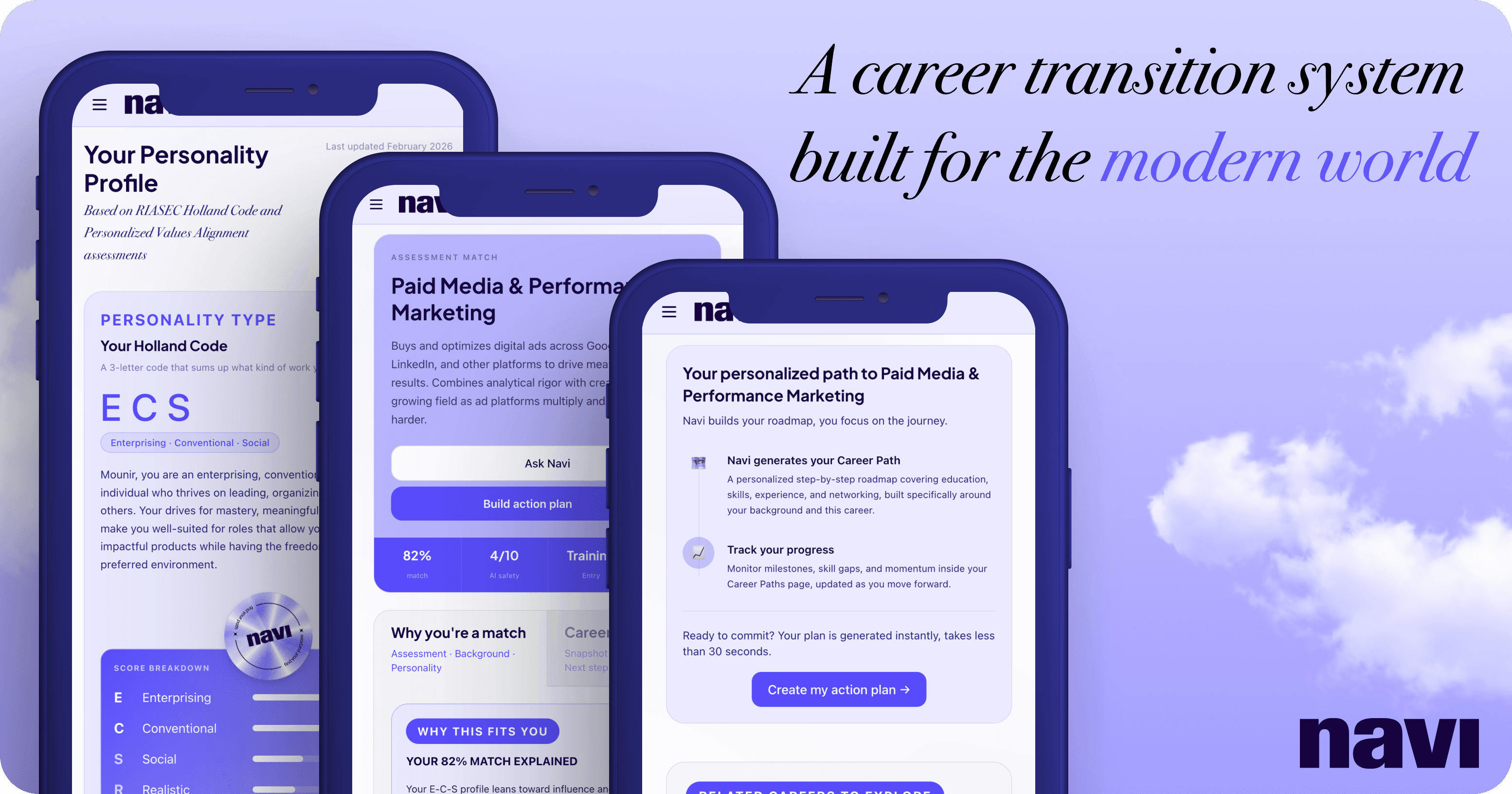
So that's what Navi built. An assessment that looks at how someone actually works, what genuinely motivates them, and what kind of environments tend to bring out their best, matched against career data built from scratch for the labor market that exists now. Every match includes an AI disruption score that shows how secure that field is likely to be over the next five years, because landing in the right direction and then watching it get automated is not a better outcome than being stuck.
The free version gives one complimentary match and a full personality breakdown. Everything that turns that into a real plan, more matches, step-by-step direction built around someone's actual background, and a virtual career coach for the questions that come up along the way, lives behind the paid version.
The old tools had their moment. The world they were built for has changed. The people using them deserve something that reflects that.
The Question Deserves a Better Answer
Thousands of people post some version of "I don't know what to do with my life" every single day. That's not a generation of unusually lost people. That's the predictable result of a system that has been handing people outdated labels and calling it guidance for eighty years.
The question hasn't changed. The world the answer has to fit has changed completely. It's time the tools caught up.
The career that actually suits who you are is only 15 minutes away.
Sponsored content from Navi.
The career tools most people are using were built before
their parents were born.
See what a modern career tool looks like.