The Part of Your Job AI Can't Touch (And How to Find It)
The people who thrive aren't ignoring AI or panicking about it. They know what makes them irreplaceable. This helps you figure out which one you are.
Read
How AI Will Change Jobs: The Future of Careers in an AI World
You've felt it already. That quiet unease when another AI tool launches and you wonder if what you do every day will still matter in five years. You're not paranoid. You're paying attention.
Most people can't answer the question "how will AI change my career" because they're looking for reassurance instead of clarity. They want someone to tell them they'll be fine. But the truth is harder and more useful: AI will change nearly every job, and the people who thrive won't be the ones who ignore it or panic about it they'll be the ones who understand what parts of their work are irreplaceable and what parts were never supposed to be human work in the first place. The problem isn't that AI is coming. It's that most people don't know which skills they have that actually can't be automated, because no one ever taught them how to find out.
This isn't another article predicting robot uprisings or promising that "soft skills will save you." This is about what's actually happening right now, what it means for your career, and how to make decisions that won't leave you scrambling in three years.
How AI Will Change Jobs Across Different Industries
AI isn't replacing jobs uniformly. It's reshaping them asymmetrically, and the pattern matters more than the headlines.
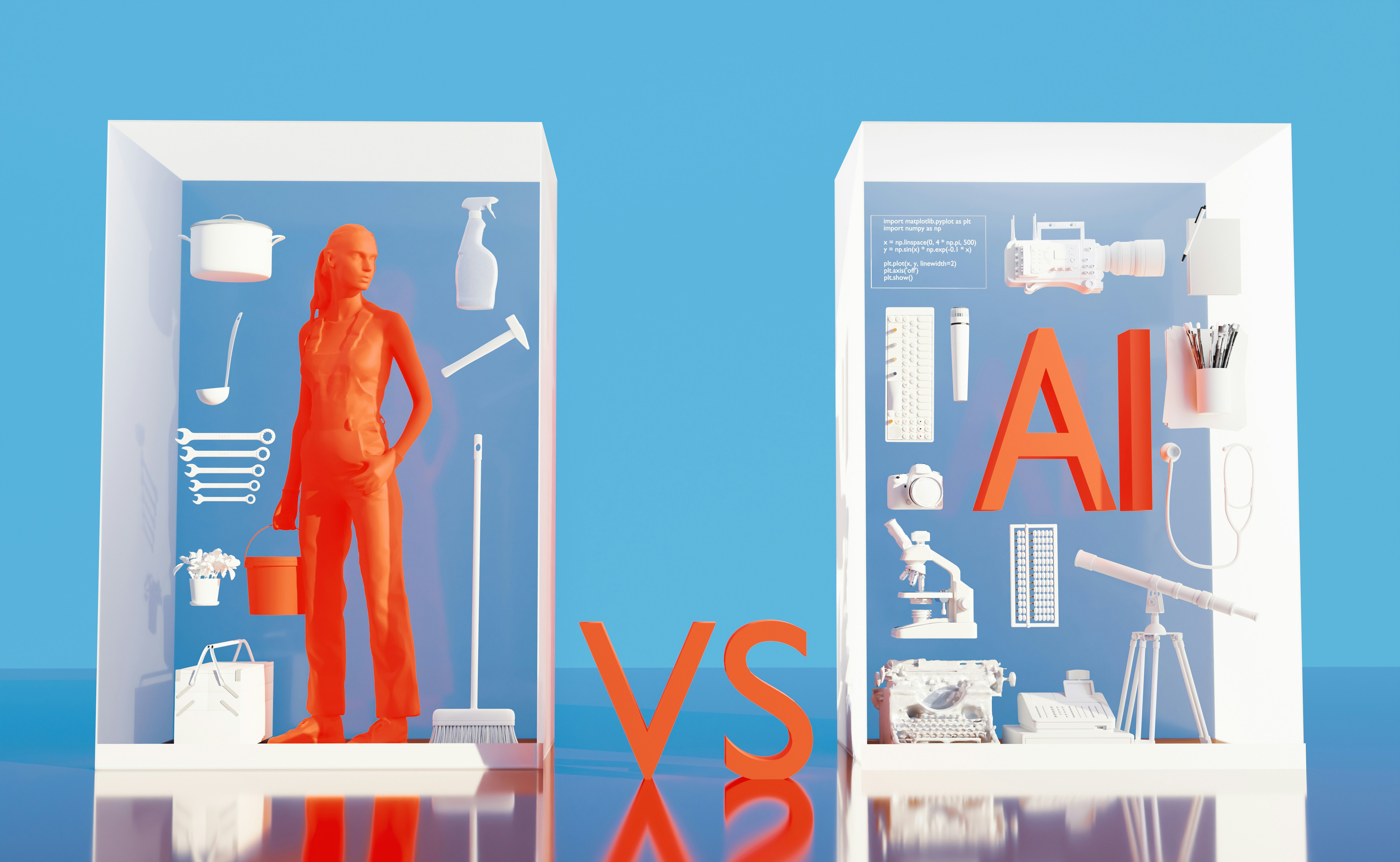
In healthcare, AI is already reading radiology scans faster than most radiologists. But it's not replacing doctors, it's changing what doctoring means. The diagnostic part, the pattern recognition, the data analysis, that's increasingly automated. What remains is the interpretation, the bedside manner, the ethical judgment calls, the ability to deliver hard news to a frightened patient. The job title stays the same. The actual work shifts.
In finance, algorithmic trading has been around for years, but now AI is writing financial reports, generating investment strategies, and detecting fraud patterns humans would miss. Junior analysts doing data entry and basic modeling? That work is vanishing. Senior strategists who understand what the numbers mean in context, who can explain risk to a nervous client, who can spot when the model is missing something the data doesn't show? They're more valuable than ever.
Marketing is splitting in two directions. AI can generate ad copy, optimize campaigns, A/B test faster than any human team, and personalize content at scale. The execution layer, designing the fiftieth variation of an email subject line, manually adjusting bid strategies, pulling reports is automating rapidly. What's left is strategy, brand understanding, cultural intuition, knowing what will resonate and why. The gap between junior marketers and senior strategists is widening, and the middle is hollowing out.
In creative fields, the shift is more psychological than practical. AI can generate images, write articles, compose music, edit video. But it can't want something. It can't have a point of view. It produces output, not vision. The creatives who survive aren't the ones with the best technical skills those skills are becoming commodified. They're the ones with taste, with something to say, with the ability to direct AI as a tool rather than compete with it as a peer.
Legal work is seeing the same bifurcation. Document review, contract analysis, legal research AI does this faster and cheaper. Paralegals and junior associates doing primarily research work are already feeling the squeeze. But litigation strategy, client counseling, negotiation, courtroom presence these remain deeply human. The lawyer who can ask the right question matters more than the one who can find the right precedent.
The pattern across all industries: routine cognitive work is automating faster than anyone expected. The jobs that remain are the ones requiring judgment, creativity, emotional intelligence, and the ability to operate in ambiguity. Not because those skills are magic, but because they're genuinely harder to code.
But here's what most articles won't tell you: the division isn't just between industries. It's within every role. If your job is primarily executing tasks someone else defined, you're exposed. If your job is defining what tasks matter in the first place, you're not just safe you're more valuable.
Jobs of the Future: Careers That Will Thrive in an AI-Driven Economy
The future job market won't just be "tech jobs" versus "everything else." It'll be more textured than that.
AI ethicists and governance specialists are already emerging. As AI makes more consequential decisions who gets a loan, who gets paroled, what content gets promoted someone has to define the rules, audit the systems, and navigate the moral complexity. This isn't a coding job. It's philosophy meets policy meets technology.
Human-AI interaction designers will shape how we actually use these tools. Right now, most AI interfaces are built by engineers for engineers. The people who can translate between what AI can do and what humans actually need designers, researchers, translators will be critical.
Trades and skilled physical work are more resilient than people assume. Electricians, plumbers, HVAC technicians, carpenters these jobs require physical presence, improvisation, and problem-solving in unpredictable environments. A robot can assemble a car on a factory line. It can't retrofit old wiring in a 1920s building where nothing is to code.
Healthcare roles requiring human presence aren't going anywhere. Nurses, physical therapists, mental health counselors, occupational therapists AI can assist, but it can't replace the human doing the work. You can't automate empathy or physical touch or the trust that builds over repeated human interaction.
Complex problem-solving roles in any field will thrive. The people who can take messy, ambiguous situations and figure out what to do strategy consultants, senior engineers, research scientists, investigative journalists are using AI as a tool, not competing with it.
Creative directors and taste-makers become more important, not less. When everyone has access to AI that can generate competent content, the differentiator is vision. Someone still has to decide what's worth making and why.
Educators and trainers will shift from information delivery to something more human. If AI can explain any concept on demand, the teacher's job isn't lecturing anymore. It's mentoring, motivating, asking the questions students don't know to ask, creating environments where learning happens.
Here's the difficult part: these aren't necessarily new job categories. They're evolutions of existing work, and the transition is already happening. If you're waiting for a clear signal that it's time to adapt, you're already late.
The question isn't "what jobs will exist." It's "what version of my work will matter five years from now, and am I building toward that version or away from it?"
Skills You Need to Future-Proof Your Career Against AI Disruption
The standard advice is "learn to code" or "develop soft skills." Both are incomplete.
Coding literacy helps, but not because everyone needs to be a developer. It helps because understanding what AI can and can't do makes you dangerous. You stop seeing it as magic or threat. You see it as a tool you can direct. You don't need to build the model. You need to know what questions to ask it.
Critical thinking sounds generic until you define it properly. It's the ability to evaluate information, spot flawed reasoning, ask better questions, and operate without perfect data. AI is very good at optimizing for the goal you give it. It's terrible at questioning whether that goal makes sense. Humans who can do that become more valuable, not less.
Communication and synthesis matter more as information becomes infinite. AI can generate a thousand-page report. Someone still has to read it, decide what matters, and explain it to people who need to make decisions. The ability to take complexity and make it clear that's not automating.
Adaptability isn't a skill, it's a posture. The people who struggle most with AI aren't the ones in "at-risk" industries. They're the ones who can't tolerate ambiguity, who need their role to stay fixed, who built their identity around doing one thing extremely well and can't imagine doing it differently. That rigidity is the real risk.
Domain expertise combined with AI fluency is the killer combination. A doctor who understands AI can use it to become a better doctor. A marketer who understands AI can do the work of an entire team. A writer who uses AI as a research assistant and draft generator can produce more thoughtful work faster. The people who lose are the ones who refuse to touch the tools or who assume the tools will do the thinking for them.
Emotional intelligence is real, but not because it's inherently unexplainable to machines. It's because the work that requires it managing people, building trust, navigating conflict, reading a room happens in contexts where human beings prefer human beings. Your manager could theoretically be an AI. You would hate it. That preference creates economic value.
But here's what no one says: skills aren't enough if you're in the wrong role. You can be adaptable, emotionally intelligent, and AI-fluent, but if your job is primarily execution, you're still exposed. The bigger question is whether you're in a role where those skills actually matter, or whether you need to move toward one.
Best Careers for the Future: High-Demand Roles in the AI Era
If you're considering a career change or just starting out, some paths have better odds than others.
Data scientists and machine learning engineers are the obvious ones, but saturation is coming. The field is growing, but so is the supply of people with those skills. Being a competent data scientist in five years will be like being a competent web developer now valuable, but not rare. The ones who thrive will combine technical skill with deep domain knowledge. A data scientist who understands healthcare or climate science or logistics is worth more than a generalist.
Cybersecurity specialists will stay in demand as long as valuable things are online and people want to steal them. AI makes both attacks and defenses more sophisticated. The arms race continues.
Sustainability and climate adaptation roles are growing regardless of AI. Environmental engineers, renewable energy technicians, urban planners focused on climate resilience these are responses to physical problems that need human solutions.
Skilled trades remain underrated. Electricians, plumbers, welders, HVAC techs these jobs pay well, can't be outsourced, and aren't automating anytime soon. The cultural bias against them is an opportunity if you can get past it.
Therapists, counselors, and mental health professionals face nearly infinite demand and near-zero automation risk. You can't Zoom-therapy your way out of needing human connection, and AI therapists remain deeply unsatisfying to most people.
Product managers and strategic operators who can bridge business, technology, and user needs will stay critical. Someone has to decide what to build and why. AI can inform that decision. It can't make it.
Sales roles that involve complex B2B relationships aren't going anywhere. Transactional sales buying a product online sure, that's automated. But selling a seven-figure enterprise software deal that involves navigating organizational politics, building trust, and customizing solutions? Still human.
Creative strategists in brand, content, and entertainment will matter more as content becomes abundant and worthless. When AI can generate infinite mediocre content, the humans who can create something people actually care about become the scarcity.
The pattern: careers that require contextual judgment, human trust, physical presence, or creative vision are safer than careers built on processing information or executing defined tasks.
But the real answer isn't a job title. It's a question: does this role require me to do something only I can do, or something anyone with the right training can do? The first has a future. The second is on borrowed time.
How to Prepare for Career Transitions as AI Reshapes the Workforce
If you're realizing your current path might not hold, the paralysis is real. You know you should do something. You don't know what.
Start by separating the noise from the signal. Most career advice right now is either fear-mongering (your job will disappear!) or toxic positivity (just be yourself!). Neither helps. What helps is honest assessment.
Audit your current role. Write down everything you actually do in a week. Not your job description, what you actually spend time on. Then ask: which of these tasks could an AI tool do right now or in two years? Which require human judgment, creativity, or relationship? If the first list is longer than the second, you're not in immediate danger, but you're in a role that's shrinking, not growing. The time to move is before you have to.
Identify your transferable skills, but be specific. "I'm good with people" doesn't mean anything. "I can de-escalate angry customers and turn them into advocates" is a skill. "I'm organized" is vague. "I can take ambiguous projects and build systems that make them repeatable" is valuable. The more specific you are, the easier it is to see where else those skills apply.
Experiment before you leap. You don't have to quit your job to start learning. Take on a side project. Freelance. Volunteer for the thing at work no one else wants to do. Test whether the career you think you want is actually the one you'd be good at. Most people don't have a career problem they have a self-awareness problem. They don't actually know what they're good at or what environments let them thrive.
Build skills in public. If you're trying to move into a new field, waiting until you're "ready" means you'll never start. Write about what you're learning. Share projects. Contribute to open source if you're technical, or create case studies if you're not. The portfolio matters more than the credential.
Network with intention, not desperation. Informational interviews sound like busywork, but they're how you learn what a job actually entails versus what you imagine. Most people are willing to talk for twenty minutes if you're genuinely curious and not just asking for a job. Ask: What does a normal week look like? What skills matter most? What do you wish you'd known starting out? You're not networking. You're researching.
Get comfortable with discomfort. Career transitions feel bad. You're bad at the new thing. You miss being competent. You wonder if you made a mistake. That's not a sign you're on the wrong path. It's a sign you're learning. The people who successfully transition are the ones who can tolerate that feeling long enough to get to the other side.
But here's the part most people avoid: sometimes the answer isn't a new skill or a new job title. It's a new framework for understanding what you actually want. You can learn Python and still feel empty if you're moving toward a career that doesn't fit who you are. That's not a skills problem. It's a clarity problem.
Conclusion: Embracing Change and Building a Resilient Career in an AI World
AI will change jobs. That's not a prediction anymore, it's already happening. The question is whether you're going to respond with clarity or panic.
The people who thrive won't be the ones who happen to be in the "right" industry. They'll be the ones who understand what makes them irreplaceable not because they're special, but because they've built careers around the things humans are actually built for. Judgment. Creativity. Connection. The ability to operate when the answer isn't clear.
But you can't build that kind of career if you don't know what you're good at, what environments let you do your best work, and what kind of problems you're wired to solve. Most people are guessing. They take jobs based on salary or status or what their parents think makes sense. Then they're surprised when it doesn't fit.
If any of this resonates, it's probably not a coincidence. Most people who end up here are already asking the right questions, they just haven't had a system to find the answers. That's what Navi is built for. The assessment takes about 20 minutes and gives you a personalized Fulfillment Map: the careers most aligned with who you actually are, not just what you've done or what's trending on LinkedIn. It won't tell you whether to learn AI or run from it. It'll tell you what kind of work actually fits you, so you can make decisions from clarity instead of fear.
The future of work isn't about avoiding AI. It's about building a career where AI makes you more of what you already are not a worse version of what a machine does better.